
The sports card industry has always been driven by the “Next Big Thing,” but as we cross the mid-point of April 2026, the market isn’t just reacting to a new star—it is being fundamentally rebuilt around one. Cooper Flagg, the Dallas Mavericks’ generational rookie, has transitioned from a hyped prospect to a market-altering force, sending “The Hobby” into a frenzy that rivals the 1986 Fleer boom or the 2019 Zion-mania.
But for the seasoned collector or the Crescent Vale investor, the “Flagg Era” isn’t just about high prices. It’s about a technical shift in how cards are manufactured, graded, and valued in the Fanatics-led landscape.
The Anatomy of a Market Surge
Just this week, the data confirms what collectors on the ground in Texas have been feeling. A Cooper Flagg Gold Geometric Redemption (one of the most coveted early releases under the new Fanatics/Topps NBA license) sold for a staggering $8,500. For context, that same card was trading for $5,800 just ten days ago.
This 46% jump isn’t an anomaly. It is the result of a “perfect storm” in the collectibles world:
On-Court Domination: Flagg isn’t just playing; he’s performing. With a recent 51-point masterpiece against Orlando and a 45-point double-double against the Lakers, he has effectively ended the Rookie of the Year debate by mid-April.
The Fanatics Monopoly: As the first true megastar to debut under the full Fanatics basketball license, his cards represent a new “blue chip” asset class for those moving away from legacy Panini products.
Low Population Realities: Collectors are finally realizing how difficult it is to pull high-grade examples of these new “thick stock” refractors.
The ‘Encore’ Lesson: The Technical Challenge of 2026 Card Stock
At Crescent Vale, we’ve always been obsessed with the physical architecture of the card. Whether it’s documenting the depth of a vintage holofoil or the weight of a premium insert, we know that specs matter.
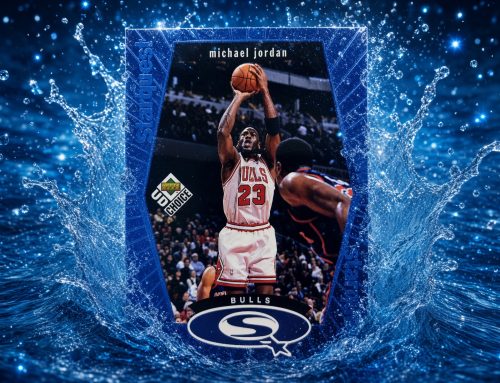
In a previous deep dive, we discussed the 1998 Upper Deck Encore set—a beautiful series that was technically listed at a 20pt thickness but often felt significantly thicker. That subtle variance caused a generation of collectors to inadvertently damage their cards by using standard-sized holders, leading to soft corners that destroyed PSA 10 potential.
History is repeating itself in 2026. This year’s Topps Chrome and Finest basketball releases are utilizing a high-density, high-gloss stock that is noticeably “thicker” than standard cardboard.
The Crescent Vale Grading Alert
If you are lucky enough to pull a Flagg or a Kon Knueppel (who is currently seeing an 80% price surge as the secondary rookie play of the year), you cannot treat them like 2024 base cards. The “Geometric” and “Mojo” parallels are unforgiving.
The Problem: The increased thickness makes the edges prone to “chipping” during the automated packing process.
The Solution: Use 55pt or 75pt top-loaders immediately. Forcing a 2026 Chrome card into a 20pt or 35pt holder will cause “surface pinch,” a flaw that professional graders like PSA and BGS are penalizing heavily this year.
Kon Knueppel: The ‘Smart Money’ Alternative
While the world chases Flagg, the sophisticated Crescent Vale collector is looking at Kon Knueppel. The Charlotte Hornets’ rookie has been trading the #1 spot on the Rookie Ladder with Flagg for much of the season.
Knueppel is shooting 43% from three-point range—a clip rarely seen by a rookie with his volume. While his high-end autos are reaching the $1,000 range, his “lower-tier” parallels are still accessible under $500. For those priced out of the $8,000 Flagg market, Knueppel represents the best ROI potential in the league right now.
The Secondary Market: eBay Trends and Live Breaks
The search volume for “Cooper Flagg eBay” is currently at an all-time high. However, we are seeing a shift in how people buy. The “Live Break” culture has evolved. In Waco and throughout the Central Texas region, local card shops are seeing a massive uptick in “Team Random” breaks where the Dallas Mavericks slot is selling for more than the rest of the NBA combined.
But a warning for our readers: Check the redemption status. Many of the most valuable Flagg cards are currently redemptions. In the transition from Panini to Fanatics, the turnaround time for these has improved, but the secondary market value of an “unscratched” redemption is currently carrying a 15% premium over the physical card due to the “grading lottery” factor.
Investment Strategy: Hold or Flip?
As we approach the NBA playoffs, the question for every Crescent Vale follower is: Do I sell the peak or hold for the future?
The Case for Selling: $8,500 for a rookie redemption is a massive liquidity event. If Flagg suffers a sophomore slump or the market stabilizes, these prices could retract by 20-30%.
The Case for Holding: Flagg is being compared to LeBron James and Victor Wembanyama in terms of cultural impact. If he leads the Mavericks deep into the playoffs this month, $8,500 might look like a bargain by June.
The Crescent Vale Verdict
The 2026 sports card market is no longer a hobby—it is an asset class. The convergence of professional-grade statistics (like Flagg’s 33 points against the Spurs yesterday) and physical manufacturing nuances (like the stock thickness) means that the winners in this market will be the ones who pay attention to the details.
Whether you are unboxing cards for your YouTube channel or quietly building a retirement portfolio in your home office in Waco, the Flagg Era is here. Protect your corners, watch the “thick stock” specs, and keep an eye on the rookie ladder.
Crescent Vale “Mail Day” Checklist for April 2026:
Check Thickness: Use 55pt+ holders for all 2026 Topps Chrome.
Monitor Knueppel: Watch for “Buy It Now” listings on Charlotte Hornets parallels.
Verify Redemptions: Only buy from sellers with 99%+ feedback when dealing with Flagg unscratched codes.
Google Maps Tip: If you’re traveling to a card show this month, remember to document your local BBQ finds on Google Maps—local guides are seeing a surge in “Travel for Hobbies” search traffic.